AixBOMS EMA
Enterprise Management Architecture (EMA)
EMA means Enterprise Management Architecture. The abbreviation is also often used here EAM for Enterprise Architecture Management is used. This contains, on the one hand, the term „Enterprise Architecture“ and, on the other hand, the word „Management“. Enterprise architecture describes the interplay of IT elements and business activities within a company. The enterprise strategy is dictated by management, and the interplay with IT is considered from this perspective. The description is usually more abstract than the pure consideration of IT architecture.
There is a connection between two subject areas that play a significant role in today's world: BPM (Business Process Management) and Configuration Management according to ITIL. The process-oriented view of BPM.
However, these approaches are not actually that different: The term BSM is an extension of Service Management, on which the entire ITIL concept
To manage these relationships, a CMDB (Configuration Management Data Base) is required. This is a federated or centralised database describing the IT infrastructure, including the interdependencies between its components and other information required for the implementation of ITIL service processes. In ITIL v3, the term CMS (Configuration Management System) introduced to further emphasise the abstraction from the physical data infrastructure and to focus solely on its role in service management. The use of multiple CMDBs and other data sources is expressly permitted; in some cases, their autonomous operation is even recommended, in order to facilitate the implementation of ITIL requirements.
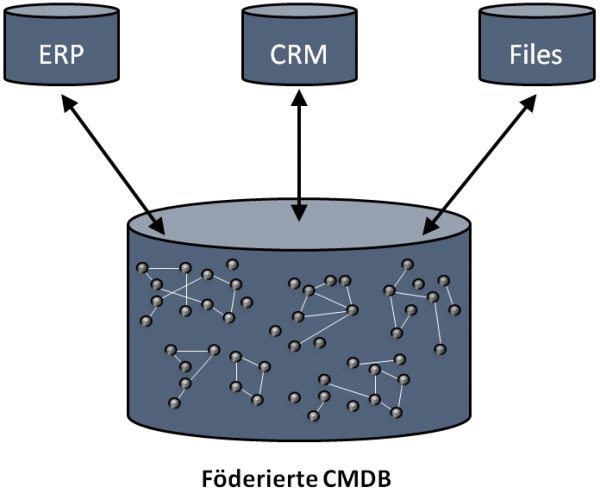
If one wishes to manage an enterprise architecture, this should be done within EMA based on its description. As far as pure management functionality is concerned, an organisation can then choose from a wide variety of options, depending on its business strategy, sector, market segments, locations, … Just as with ITIL, the data model should then be designed in such a way that it supports the various functionalities and makes them verifiable.
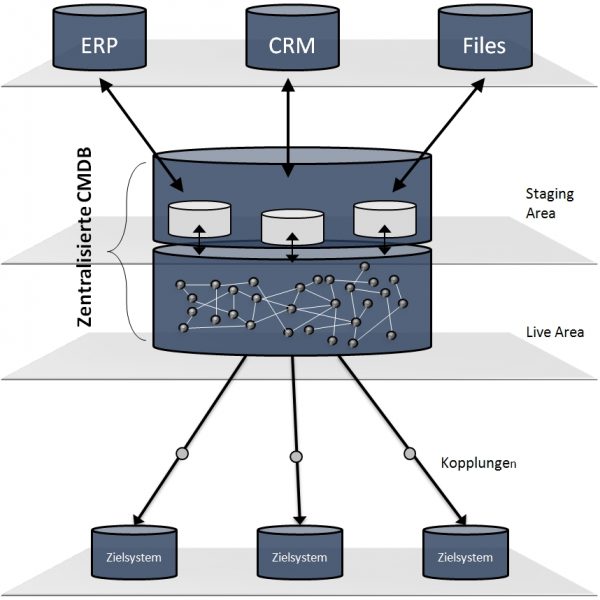
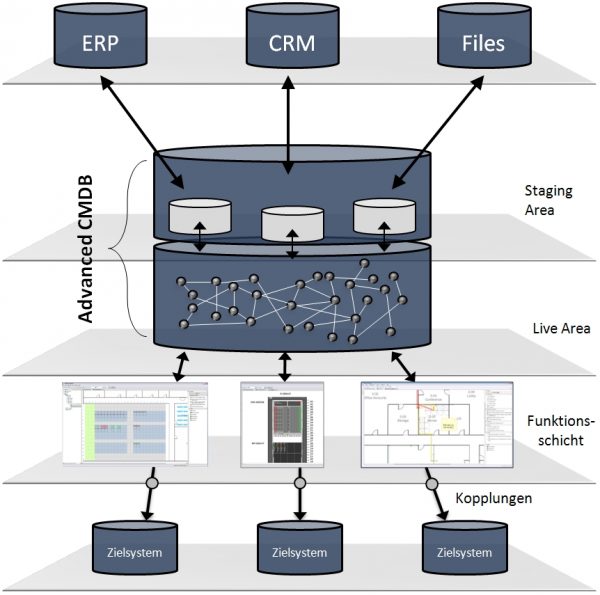
When considering the infrastructure to be managed from a management or corporate perspective, economic aspects also play a role, which are managed using renowned management tools such as SAP. However, entirely different areas such as facility management (new builds, modernisations, relocations, security, etc.) or webshops (marketing and selling products online, product catalogues) also play a part in corporate strategy. If you want to accommodate these in an ITIL-based CMDB, requirements such as openness, extensibility, and plausibility must be included.
Federated CMDBs will sooner or later reach their limits, whereas centralised CMDBs can only be sustained in the long run if they have sufficient reconciliation/standardisation procedures. Concepts and implementations in the areas of EAI (Enterprise Application Integration), Data Warehouse, ETL (Extract-Transform-Load), Reconciliation, etc., already exist here.
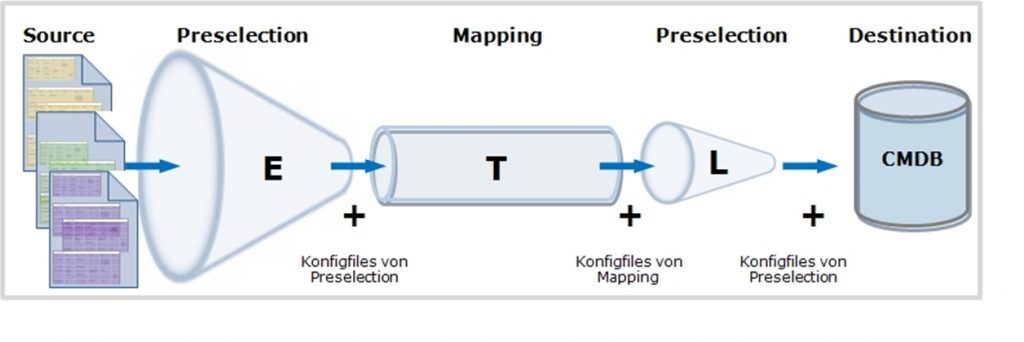
Our AixBOMS CMDB is a centralised CMDB. With its management applications, it already meets a large part of the ITILv3 requirements for a CMS. The concept of federation was dismissed from the very start of product development as not general enough and not future-proof. Instead, many years of experience from customer environments and the analysis of products from other manufacturers were incorporated into the development of a professional, secure, and high-performance ETL algorithm included.
The meta-data model makes a significant contribution to integration with other management areas within the ETL process's transformation step, by describing how source data should be used to build the CMDB model. A sophisticated set of rules, which has been used in practice for many years, can be accessed here. This allows for the correction of many data errors, incompatibilities, and information gaps early on, enabling us to work with a large, consistent data basis for our clients in a very short time.
The particular characteristic and the prerequisite for this is Staging Area, whose concept and technology we invented and already introduced to our customers with our second product generation.
This is a transition area in the CMDB that has the same structure and methods as the live area. This allows histories to be managed in the same way as current information. However, the transition area fundamentally serves to review uncertain data, which is gradually automated via ETL processes. It provides the prerequisite for a learning integration concept, which, together with the open data model, makes the product not only usable for other IT environments but also allows entirely different management areas such as EMA, ERP, ITSM, or facility management to be included.
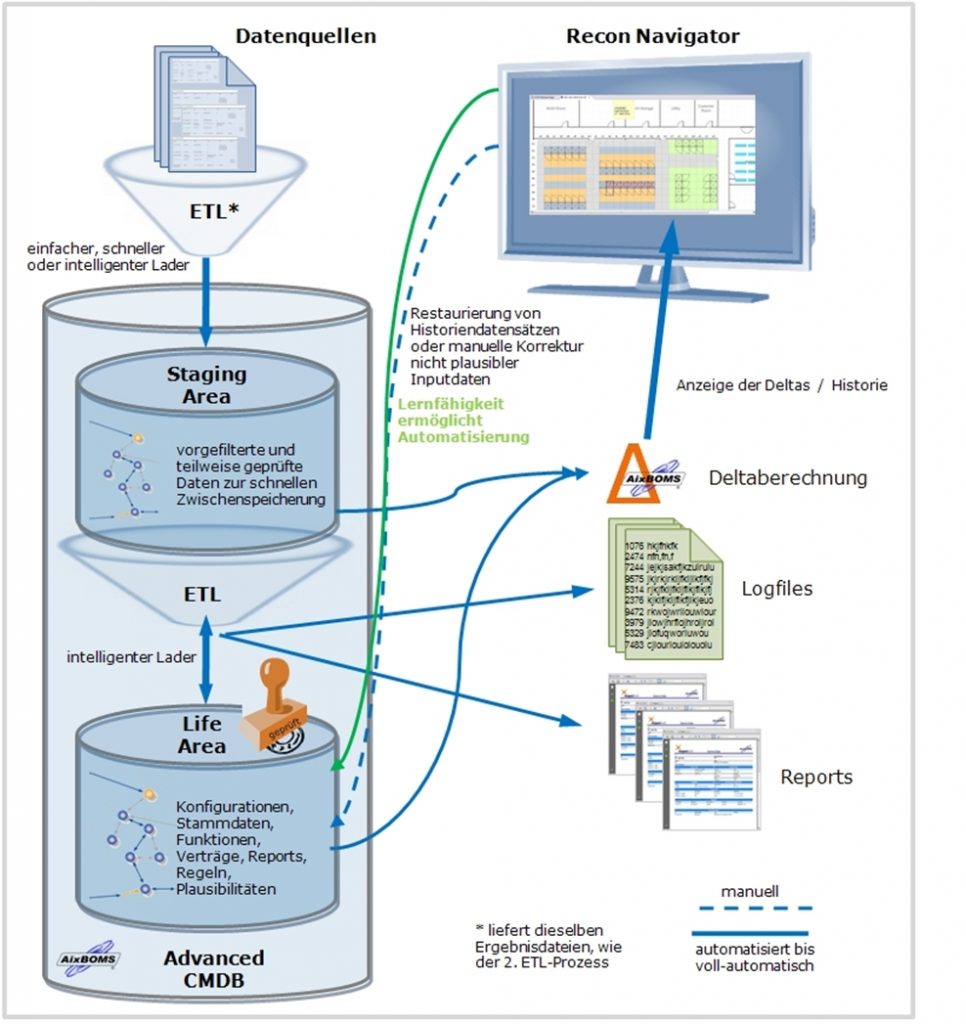
The extent to which such an integration can be fully or only partially realised critically depends on the desired management disciplines and the products already used for them. For the mapping of the IT infrastructure, a CMDB offers decisive advantages and is often a necessary prerequisite for interaction with other management areas.