AixBOMS and ERP
AixBOMS and Enterprise Resource Planning (ERP)
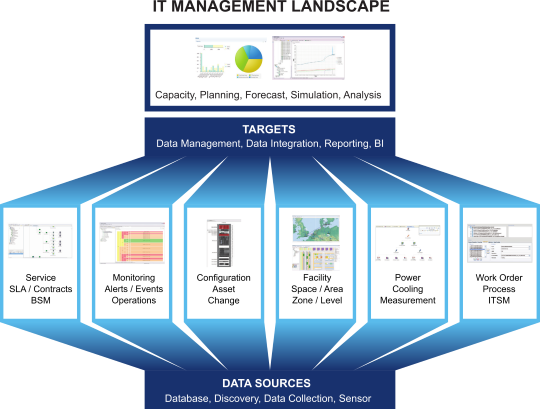
The latest press reports and practical experience show that a CMDB from a customer's perspective and not a purely technically oriented, federated data collection Federated CMDB from automatically determinable raw data (Discovery), but rather through enrichment with master data, contract data, building infrastructure and technology (Facility Management) or non-IT components (Non-IT). to a central information hub within the company will.
This becomes clear, for example, when configuration or connection components that cannot be determined automatically (e.g. passive technology like cabinets, cabling) or spatial aspects (footprints of a data centre, available data sockets in an office room) are deliberately excluded from the CMDB's range of requirements due to a lack of functional availability.
Paradoxically, such function blocks are intended to be taken over by (further) specialist systems, which renders the raison d'être of the CMDB (central data pool for IT infrastructures and configurations) absurd. After all, the number of necessary data interfaces and integrations (media breaks), poor quality of raw data, and duplicate maintenance should also be minimised. What use is the gilded individual data record without knowledge of the environmental relationships, variables, and capacities?
This also applies to the process or service-oriented (ITIL) view. Therefore, in the planning and execution scenario for Service, Incident, Problem, Change, Release, and Capacity Management, it is not necessary to know the current or free rack space for servers or to include the power and cooling capacity of my server room in the planning?
Rather, one can confidently consider the maximum benefit for added value or benefit considerations in the context of a technical CMDB including „Enterprise Resource Planning (ERP)“ configuration search.
AixBOMS provides within a unified system environment Master data management (e.g. locations, companies, people, organisational units, etc.), business data management (contracts, cost centres, costs, assets, documents, etc.) or Non-IT Administration (Equipment, Furnishings, Building Services, Area, etc.) to fulfil your requirements from an overall architectural perspective.