Assignment methods for dual-stack operation
If you are already planning your IPv6 rollout, you can also approach this gradually using AixBOMS, via dual IPv4/IPv6 operation. Two methods are available for the automatic and automated assignment of addresses.
Integration of master and CMDB data in address allocation and network organisation
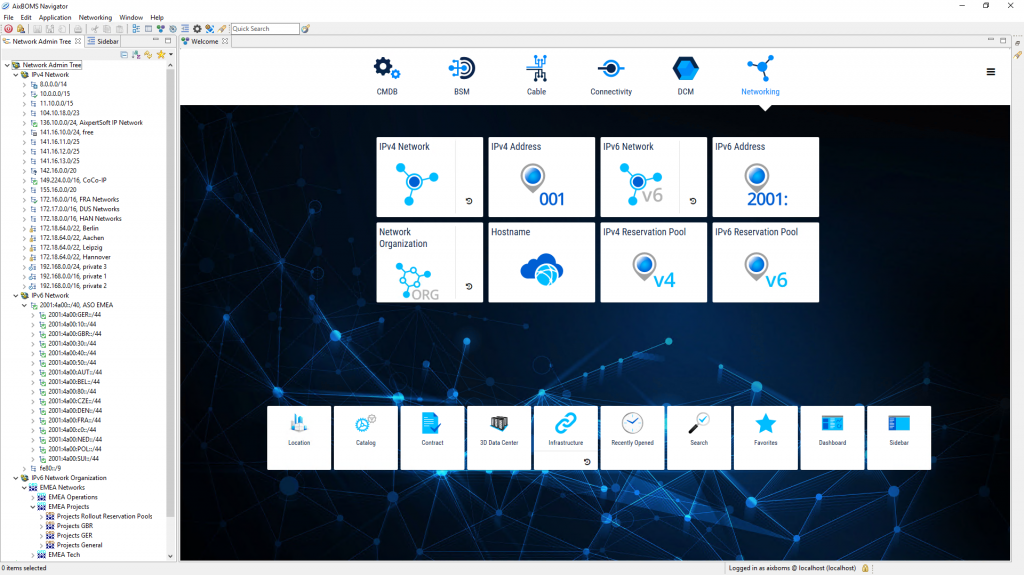
Networking, like all AixBOMS applications, is based on the common CMDB. This makes it easy to establish relationships with data from other management areas, which are helpful for planning, billing, and troubleshooting. The new extensions offer network and hostname objects that can be integrated into this service and relationship model, just like infrastructure and service objects.
Reservation pools, hostname generator, DHCP/DNS support
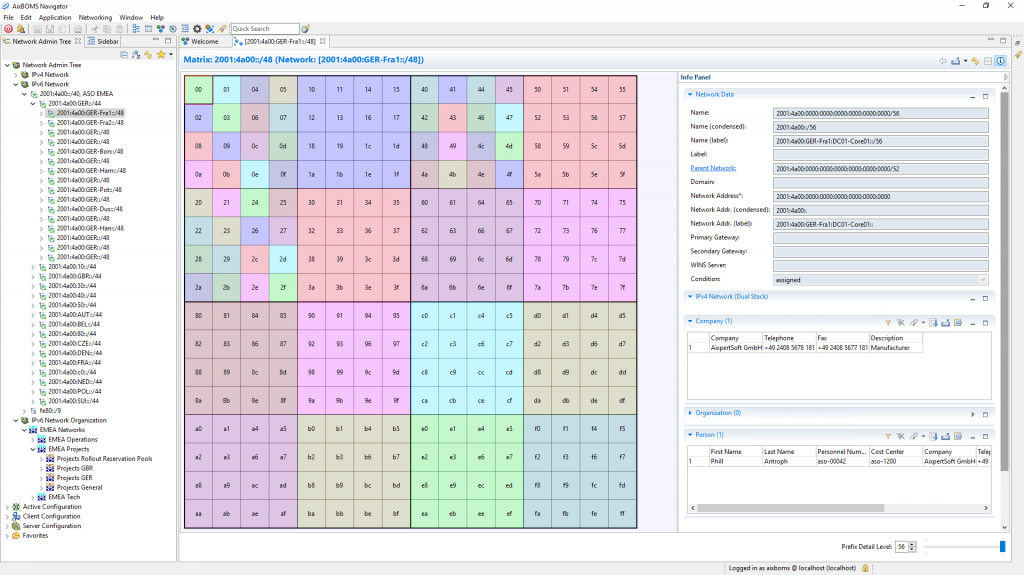
Specially for IPv6, new subnetting assistants and human-friendly notations for the 128-bit addresses have been introduced, which considerably simplify handling the enormous address spaces. A hostname generator creates company-compliant hostnames from individual name sequences (prefix, suffix, counter), which can be specified by the customer. In addition, the AixBOMS rules for working with IPv6 have been extended, thereby avoiding errors in network management.
Logical Objects (VLANs, Network Organisation, Access Groups etc.)
Reservation pools enable IPv6 networks to be logically partitioned or individual network ranges to be reserved for DHCP, customers, projects, etc. A key feature of the networking application is the management of logical structures such as VLANs (Virtual Local Area Networks) and Access Groups. This is reflected in the organisational concept for IPv6 networks: the network structure can be defined according to any criteria. For example, organisational, geographical, or technical conditions, or a combination thereof, are possible.