What exactly is DCIM 2.0?
When embarking on the search for a DCIM product, one encounters a variety of disparate tools. Among these are many that are offered for space utilisation and pure power and climate management, and are frequently assigned to facility management. The proportion of such tools that also support the management of IT components within them, such as distribution cabinets, routers, switches and storage systems, as well as their change management and billing, is vanishingly small. At the latest, most providers falter when it comes to topics such as virtual systems, cabling, patch management, network connections and addressing. However, these are precisely the characteristics that are indispensable for modern, service-oriented data centre management.
DCIM is more than power and cooling management in data centres
DCIM means „Management of Infrastructure of a data centre (Data Centre Infrastructure Management).
From the perspective of data centre operators, the requirements for this have noticeably changed in recent years. Given the increasing virtualisation and service operation for customers from a wide range of industries, the assignment to facility management is no longer up-to-date. In addition to planning support and supply monitoring of the physical, logical, and virtual, IT and non-IT components in the data centre, powerful tools are also in demand for simplifying and securing typical workflows, as well as SLA/customer-based billing. For many Internet Service Providers, a particularly high level of detail in the information is required in order to, for example, assign and bill customers for port-based services.
DCIM Subject Areas
- Electricity (Allocation / Connection to the supply network, demand determination, monitoring of supply components, ...)
- Climate (Monitoring heat development, controlling cooling systems, bottlenecks, …)
- Areas (reserved areas, planning, utilisation, …)
- Distribution cabinets (Installation of cabinets, relocation and installation of components, cabling, identification of virtual systems, …)
- Infrastructure (Exchange, Installation, Configuration, Monitoring, Planning, Repair, IMAC/D, Templates, Business Rules, …)
- Wiring (Port-based reports, cable routing, work orders, workflows, ...)
- Connectivity (Network paths, SDN, path search by criteria/SLA, …)
- IPAM (IPv6, logical/organisational networks, VLAN, DDI, hostnames, …)
- Monitoring and BSM (Real-time monitoring of central components/SLA parameters, alarms, service dependencies, impact analysis, ...)
- Automation and workflows
- Invoice (customer-/port-based, area-/rack-/component-utilisation, virtual systems, …)
- Access protection
Holistic approach
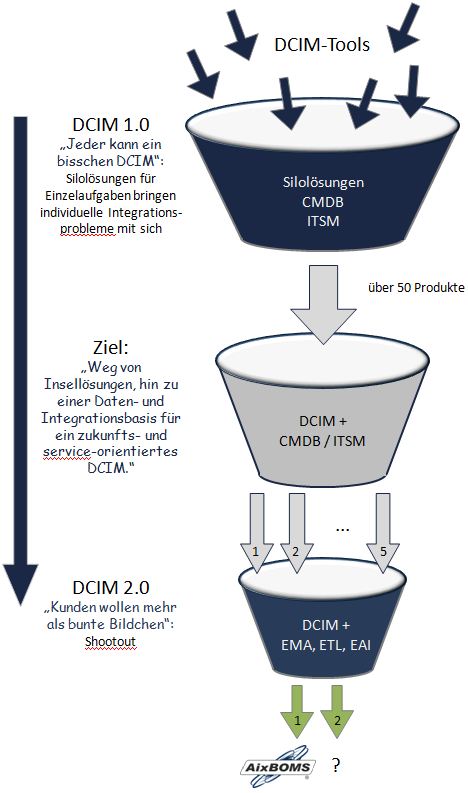
This has led to a huge number of tools currently on the market, all claiming to „do DCIM“. These are mostly silo solutions for individual components within the data centre or task areas of DCIM, whose interaction can be implemented poorly or not at all in practice. Even when integration interfaces are offered, it is often up to the customer to utilise these for their own environment. The resulting follow-up projects typically cost several times the amount of time required for the commissioning of the actual DCIM tool.
1. Wave „Market Consolidation“
These shortcomings have led to calls for a clear definition for DCIM (DCIM 2.0). It is currently assumed that after a first wave of consolidation among some DCIM manufacturers, approximately 50 vendors will remain. These will include market-relevant and traditional silo solutions, as well as products from the service management sector.
Service providers shape DCIM development
Due to expected developments in the service and cloud provider business (housing, hosting, virtualisation, IPv6, etc.), it is anticipated that service-based solutions in particular will become more important. In contrast to DCIM, there are already a number of specifications and standards in this area (ITIL, ISO 900x, ITSM, etc.) where customer focus is particularly prominent. ITIL (IT Infrastructure Library), for example, pursues a holistic approach in this environment for managing IT infrastructures based on a CMDB (Configuration Management Data Base) or a CMS (Configuration Management System) and has laid many foundations for the processing and management of services in the service area. Some manufacturers now use the term SMDB for Service Management Data Base to underline their currency in the service trend, although from an ITIL perspective, this is already comprehensively covered by the traditional term CMDB.
Holistic approach
This has led to a huge number of tools currently on the market, all claiming to „do DCIM“. These are mostly silo solutions for individual components within the data centre or task areas of DCIM, whose interaction can be implemented poorly or not at all in practice. Even when integration interfaces are offered, it is often up to the customer to utilise these for their own environment. The resulting follow-up projects typically cost several times the amount of time required for the commissioning of the actual DCIM tool.
1. Wave „Market Consolidation“
These shortcomings have led to calls for a clear definition for DCIM (DCIM 2.0). It is currently assumed that after a first wave of consolidation among some DCIM manufacturers, approximately 50 vendors will remain. These will include market-relevant and traditional silo solutions, as well as products from the service management sector.
Service providers shape DCIM development
Due to expected developments in the service and cloud provider business (housing, hosting, virtualisation, IPv6, etc.), it is anticipated that service-based solutions in particular will become more important. In contrast to DCIM, there are already a number of specifications and standards in this area (ITIL, ISO 900x, ITSM, etc.) where customer focus is particularly prominent. ITIL (IT Infrastructure Library), for example, pursues a holistic approach in this environment for managing IT infrastructures based on a CMDB (Configuration Management Data Base) or a CMS (Configuration Management System) and has laid many foundations for the processing and management of services in the service area. Some manufacturers now use the term SMDB for Service Management Data Base to underline their currency in the service trend, although from an ITIL perspective, this is already comprehensively covered by the traditional term CMDB.
2. Wave „Shootout“
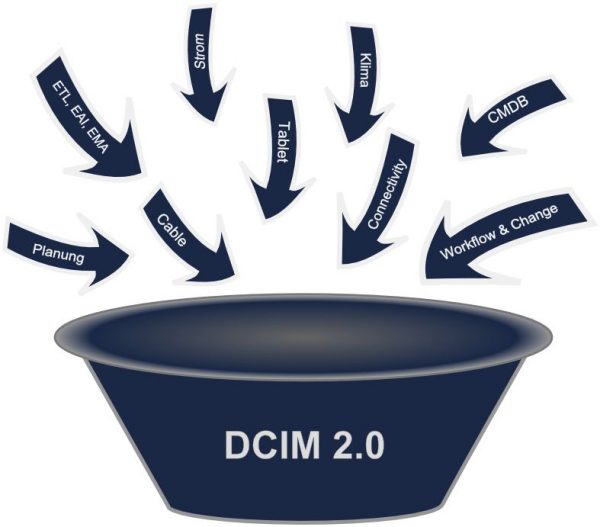
The service-based tools come from various management areas. For DCIM 2.0, only those that cover essential data centre management disciplines will remain, such as climate and power management, planning, rack management down to port level, and cabling. To be prepared for specific requirements in the respective customer environment (e.g., integration of special non-IT elements such as sensors) and also for future developments, alongside service orientation, the expandability of the application (ETL, EAI, EMA, ...) are requirements in DCIM 2.0.
The general trend in end devices will also have an enormous impact on development in the DCIM market. Smartphones and tablets are also making inroads into the administration of complex IT systems via touchscreen. Accordingly, it can be expected that DCIM apps will leave web-based solutions behind.