Why is data center management more than DCIM?
Following the DCIM hype of previous years, the initial euphoria has somewhat faded. Many stakeholders have now realised that DCIM cannot offer a comprehensive solution for managing their data centres. Numerous Press article and voices at professional congresses support this thesis and see significant differences between what is understood as DCIM today and what data centre management should achieve.
DCIM versus DCM
When it comes to DCIM, nowadays people think of:
- Measurement,
- Management of IT and telecommunications infrastructures,
- Facility Management (Buildings, Power & Climate Control).
However, data centre management must be able to do far more in the service-oriented daily operations of a data centre, such as:
- Service orientation and monitoring
- Workflow integration (ITSM, Asset & Order)
- Network management
- Cable and connection management
- Lifecycle Management
- active control of peripheral systems.
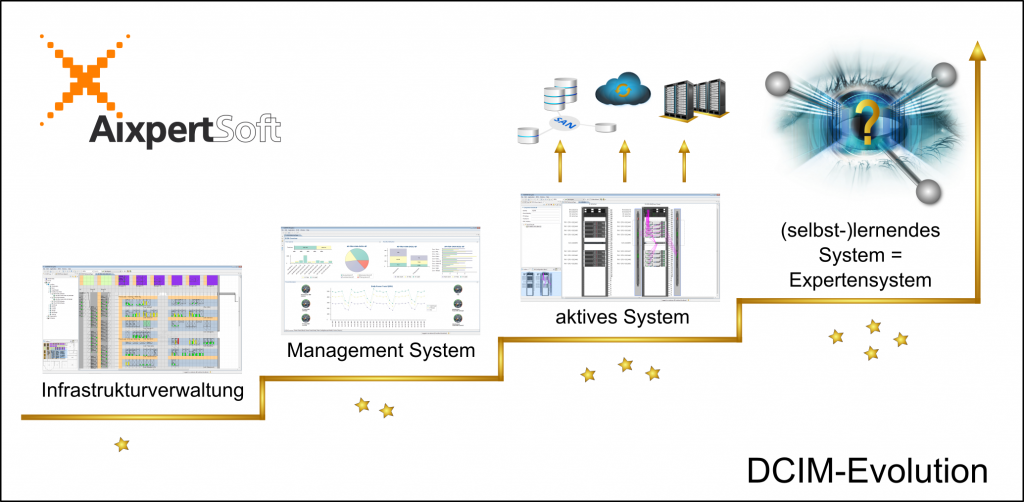
DC(I)M-Evolution
The reason these two terms raise such different expectations can be explained by the evolution of data centre operations and IT and service infrastructure. It requires new management areas that were previously not possible or were handled manually. The rapid increase in and variety of components (manageable power outlets, sensors, etc.) along with increasing „service-ification“ lead to the use of new tools and an increasingly automated way of working. This also affects the monitoring and control of components, turning traditionally passive infrastructure management into an increasingly active management system.
The DCM strategy
Fundamentally, data centre operation is shaped by the customer's specific business. As such, it may be the case that only a subset of the individual disciplines listed is required. The size of the data centre, the company and its organisation, its customer connectivity, its service level, and its future direction play a significant role in this. Many DCIM tools are inadequately equipped for this. In order to operate data centre management appropriately, the customer runs the risk of it being with a Management Landscape, This means dealing with a variety of tools and corresponding integration issues. Alternatively, they must arrange for the use of a „Data Repository“, a data broker that supports DCIM as a discipline, among other things.
To establish qualified Data Centre Management, it is therefore recommended to align the customer's tool requirements with their current and future business and operational model. Existing tools and processes must also be evaluated and incorporated into the overall strategy. However, this does not mean that established disciplines such as ITIL processes must necessarily be replicated in a DCIM tool. Whether a centralised approach using a data repository or multiple silo systems is preferable can only be clarified on a case-by-case basis.
To achieve maximum added value, we recommend the following approach:
- Subject Fulfillment (Check Silos)
- Integration (Data Repository)
- Substitution (Replacing silos)
- Overall strategy.
You can find further information in our Technical articles.