AixBOMS and ITSM
ITSM-Systeme werden eingesetzt, um den gesamten Lebenszyklus von IT-Services zu verwalten, einschliesslich Planung, Bereitstellung, Management und Verbesserung. Sie helfen Organisationen dabei, ihre IT-Services effizient und effektiv zu erbringen und sicherzustellen, dass sie die Geschäftsziele unterstützen.
ITSM suites are used to support user services (Service Desk) and IT operations, and primarily concern tasks for Incident, Problem, Release, Change, and Configuration Management. The definition, creation, execution, and maintenance of processes based on building blocks and automated workflows, as well as their assessment and evaluation through sophisticated reporting, are of particular importance.
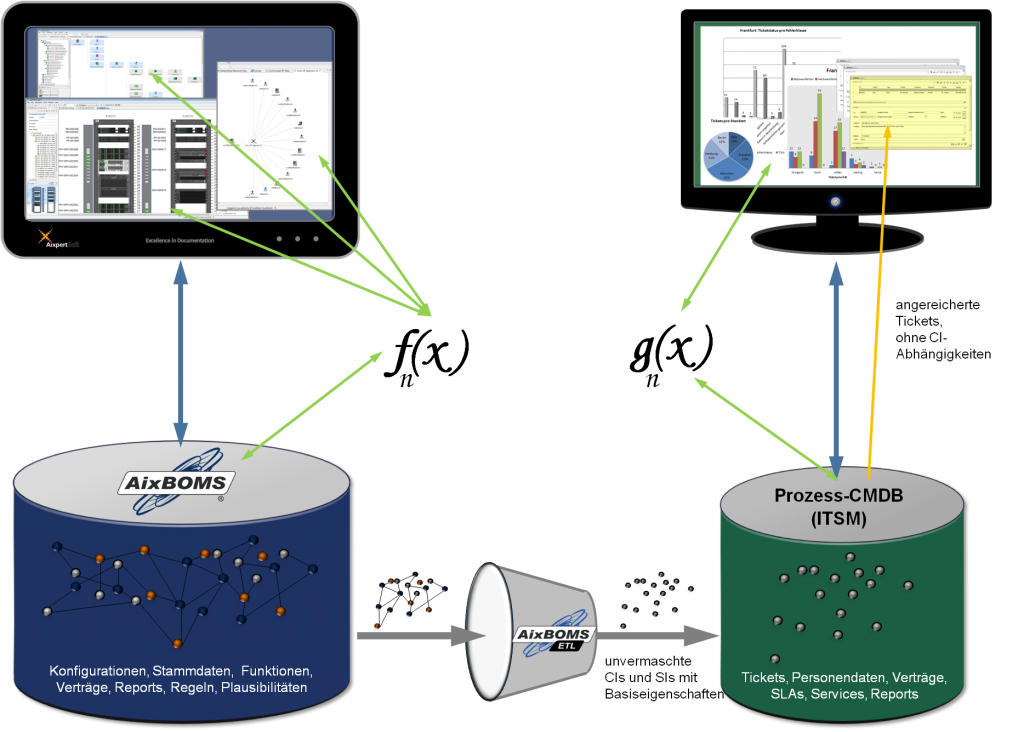
ITSM systems typically have a process CMDB with functions for workflow definition, escalation mechanisms, role assignment, and process control. A technical CMDB, on the other hand, offers master data management, technical assets, cable & connectivity management, networking (e.g., IP address management for IPv4 or IPv6 addresses), data centre infrastructure management, and business service management. It focuses on the multifaceted relationships between managed objects, which also affect the required quality assurance rules.
The weaknesses of ITSM systems in a holistic management approach
The CMDBs of ITSM systems are often based on a generic data model, meaning individual system classes such as servers, routers, end devices, etc., are not well-defined in their depth of detail, and logical information such as IP addresses, network connectivity - and connections, security zones, etc., are sometimes not included at all. Consequently, such systems must be extensively adapted by the customer for the desired realistic representation and management. This is usually done by adding attributes that are maintained by the responsible specialist departments. Rules for comprehensive plausibility checks are rarely present. Furthermore, visualisation options for complex system architectures like cabinet views, network structures, building plans, etc., or graphical editing capabilities are often missing.
What ITSM features does AixBOMS offer?
AixBOMS has its own workflow engine, which controls and automises all work processes within the IT Management Landscape. Using the AixBOMS Workflow Designer, you can graphically break down a workflow into sub-processes, assign activities, allocate roles for execution, and agree on conditions for transitions from one activity to another. Once defined, activities can easily be modified and reused for later processes. The Problem Management application for the Incident and Problem discipline, as part of the AixBOMS Suite, is programmed for close interaction with the other modules. The focus is on the execution of complex, technical processes of change management at the touch of a button, address allocation (IPv4 / IPv6), proactive capacity planning (rack space, rack units, virtual machines), and sophisticated configuration management.
The integration of ITSM systems and AixBOMS
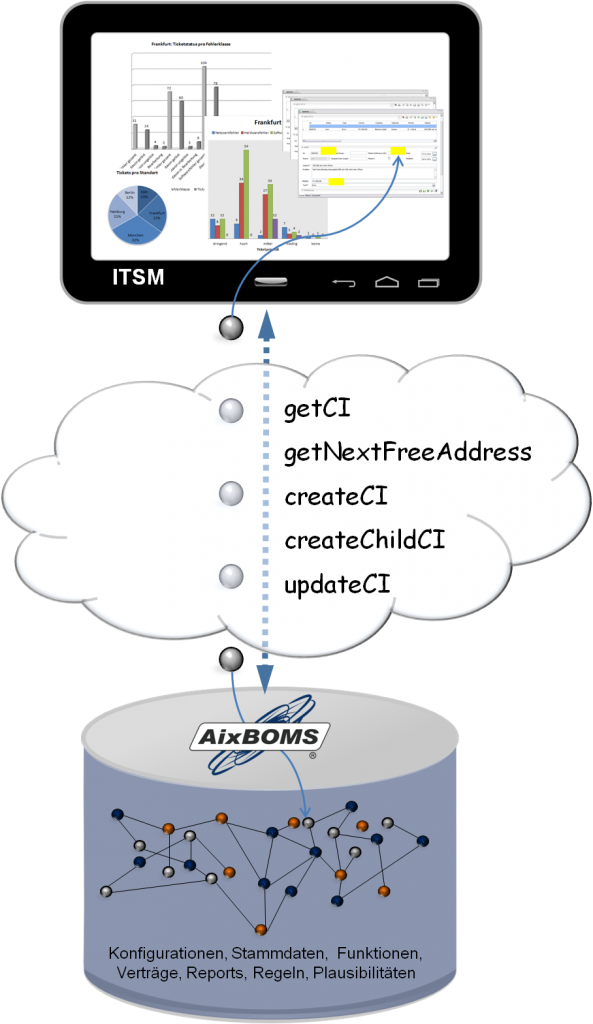
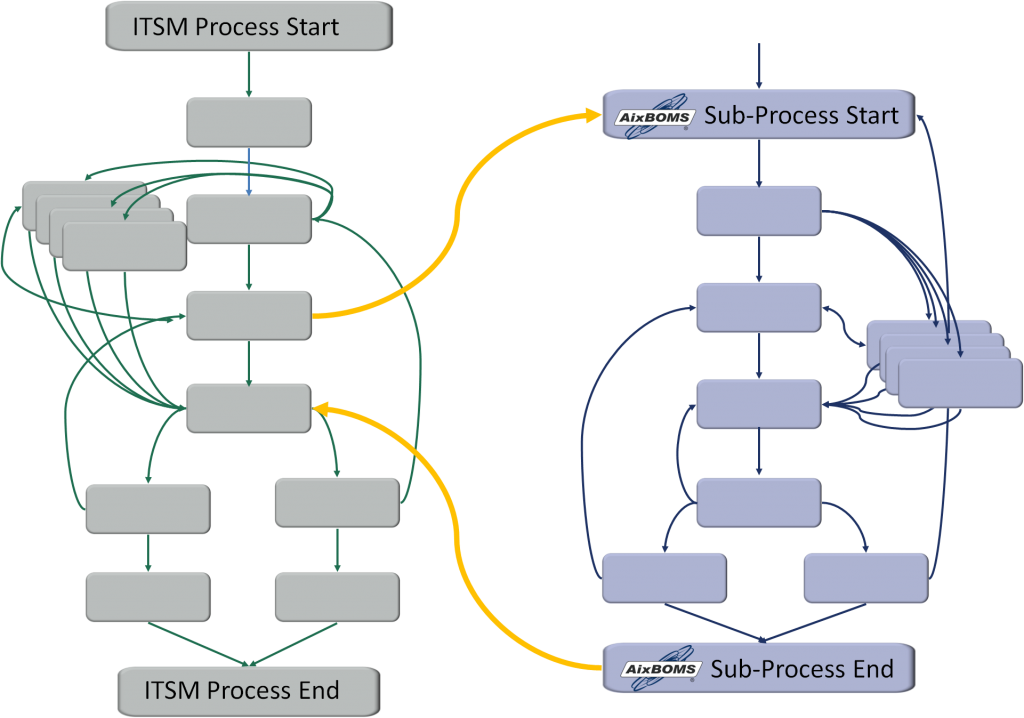
Since many enterprise customer environments already use ITSM systems and process CMDBs, the required technical sub-processes are called as individual processes in the ITSM system, processed in AixBOMS, and handed back to the ITSM system upon completion.
A simpler form of interaction is GUI integration. This allows detailed CI data from AixBOMS to be displayed from the ITSM interface at the push of a button or via permanent data exchange. Conversely, affected incident, problem, and change tickets can be viewed on the CI in AixBOMS. This is realised via REST calls. In very few cases are complete database comparisons carried out due to duplicate data storage.