Sustainable and top-tier computing power thanks to renewable energy.
„Energy-Optimised Supercomputer Networks using Wind Energy (ESN4NW)
Behind this title lies a new research project at SICP (Software Innovation Campus Paderborn) under the direction of the University of Paderborn. The project, funded by the Federal Ministry of Education and Research (BMBF), belongs to the technology field of energy-efficient High-Performance Computing (HPC) to be assigned.
The concept of combining a new HPC infrastructure with a sustainable operational management approach was developed collaboratively with SICP member WestfalenWIND IT, the operator of WindCORES. At its core, the project aims to research and demonstrate the potential and adaptability of WindCORES for HPC IT systems when powered by volatile renewable energy. The seven consortium partners from industry and academia successfully convinced the reviewers with their goal of highly integrated operational management for the optimised use of directly available local renewable energy and the exploitation of waste heat sinks/benefits, such as the tower of a wind turbine (WT).
To demonstrate innovation, an integrated design approach that goes far beyond the current state of the art shall be pursued and implemented. In addition to the development of an adapted infrastructure, a monitoring and operating platform (DCIM), new knowledge bases, operating strategies and, in particular, sustainability assessments of possible architectures will be researched for operation management optimised for sustainability. The addressed decentralised operation of an HPC cluster distributed across multiple wind turbines requires behavioural and predictive models that are not currently available. The scientific and technical challenges in the project include, among others, intensive data acquisition and utilisation, the integration of artificial intelligence into control loops, as well as the systemic integration of all models via a digital twin. Central to this are predictions about weather-dependent local energy availability in the local grid and thus also energy availability in a wind turbine, as well as precise behavioural models of all interacting trades regarding their power consumption and heat dissipation requirements.
A special feature and innovation in the concept: the tower of a wind turbine is not only integrated as a potential heat sink, but the cooling capacity, combined with energy availability, forms the control variable for the operational management of the HPC systems – computing only when renewable energy and waste heat users are available. In the current project, the focus is on technical and economic feasibility, the functional and didactic demonstration of operational management, and the sustainability assessment of the system over its extended life cycle. The intended results should be fundamentally transferable to future systems involving waste heat generators and waste heat users in the HPC context.
The SICP, together with its co-partners, is convinced of the concept's exemplary role from an economic and scientific perspective: „The project particularly addresses the indispensable challenges of the energy transition and digitalisation. The results of the project will demonstrably show that the growing energy demand of digitalisation does not form a dead end for greater sustainability and that these growth needs can also be met flexibly in terms of time and space by renewable energies,“ explains Dr. Fiete Dubberke.
„The current topic of „How can we utilise waste heat from the most diverse industrial sectors?“ will also be addressed. Which systems of producers and users should be sensibly connected, and what tasks can AI methods take on in this context,“ says Dr. Gunnar Schomaker, referring to the further potential of the research results. The award-winning windCORES concept has already shown that merging a wind turbine with a data centre can also be implemented successfully from an economic perspective. „The successful operation of an HPC cluster, which merges several local individual wind turbine plants into an HPC data centre network, is the central driver for the project,“ explains Dr. Lutz Stobbe.
Our consortium partners

Paderborn University, SI-Lab (SICP)
The SI-Lab is a central scientific facility of Paderborn University and the transdisciplinary research network SICP for data- and software-driven innovations in socio-technical ecosystems. The project is coordinated there and scientifically implemented by Jun.-Prof. Dr. Sebastian Peitz at the Data Science for Engineering chair, Prof. Dr. Henning Meschede at the Energy Systems Engineering chair, and Dr. Gunnar Schomaker.

Fraunhofer Institute for Reliability and Microintegration – IZM
Fraunhofer IZM is a world-leading research institute in the field of assembly and interconnection technology for microelectronic systems. The Environmental and Reliability Engineering (ERE) department specialises in the ecological and economic assessment and optimisation of electronics/ICT. As an expert, Dr Lutz Stobbe supports complex modelling and analysis of environmentally relevant impacts within the project.

University of Passau
The project is being implemented at the Chair of Computer Science with a focus on Computer Networks and Communication, led by Prof. Dr.-Ing. Hermann de Meer. For over 15 years, the Chair has been researching topics related to energy efficiency in data centres and the digitalisation of the energy system for the integration of renewable energies.

WestfalenWIND IT
The Paderborn-based company is a subsidiary of the WestfalenWIND Group, which operates 180 wind turbines with a total output of approximately 450 MW. The corporate group's aim is to develop and maximise sustainable energy generation. The group is a member of SICP and is researching innovations there, such as windCORES, a multi-award-winning and globally unique concept for the sustainable operation of data centres in wind turbine towers – energy utilisation directly from the wind turbine.
Our project contribution
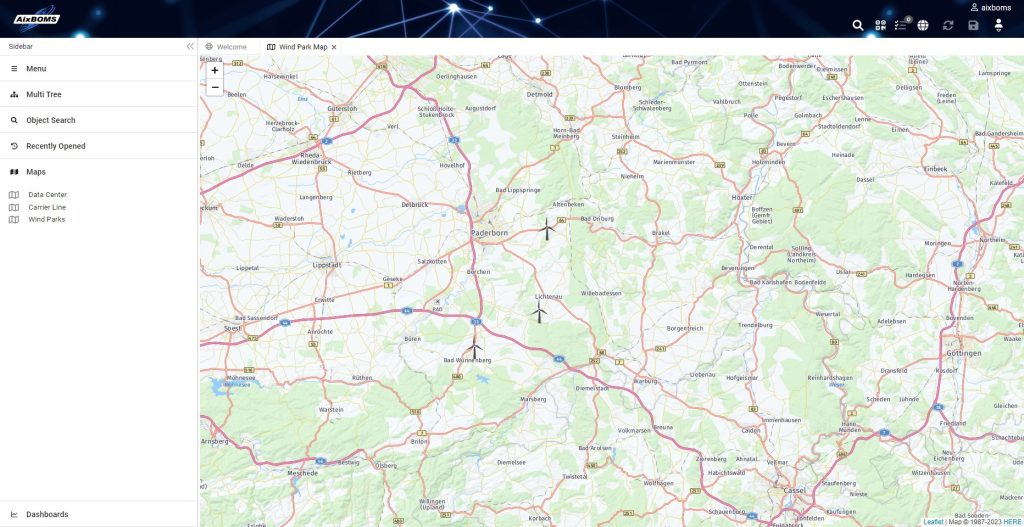
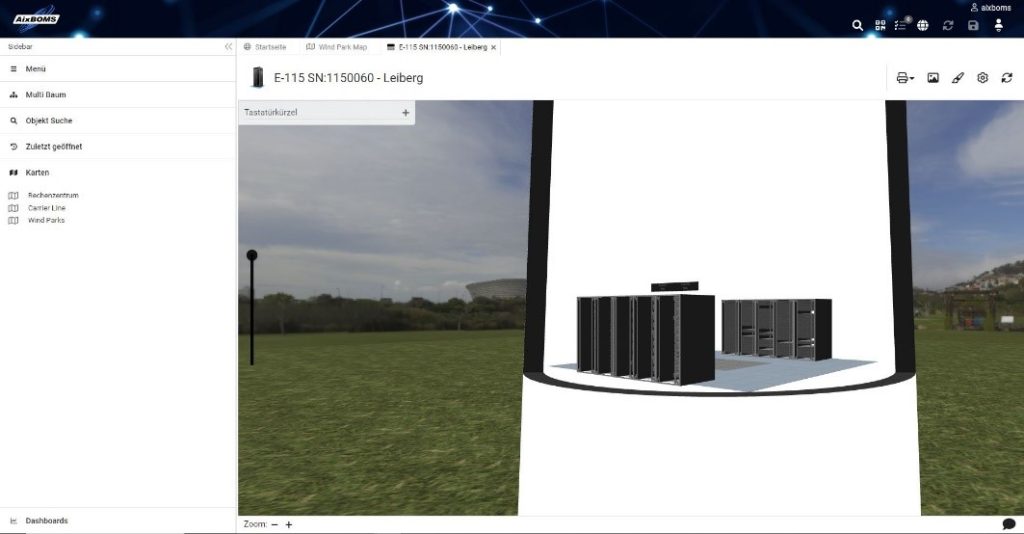
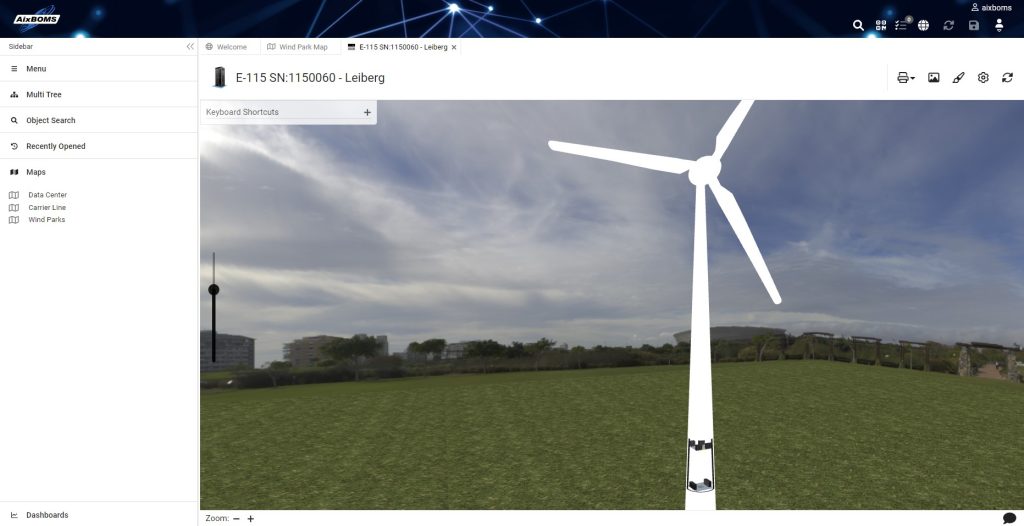
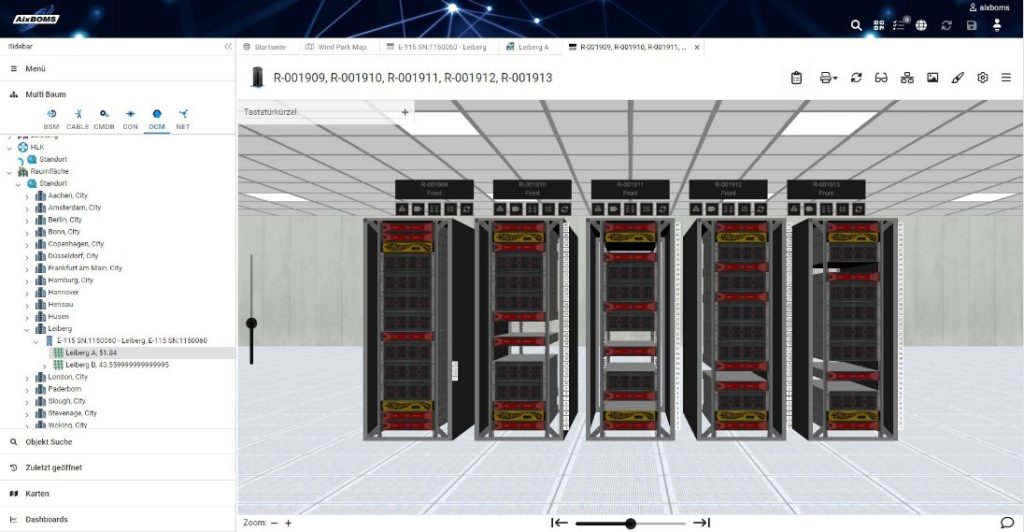
- Digital Twin in AixBOMS
- 3D DC View of the Data Centre
- Advanced monitoring and management tools
- Cluster Simulation and Functional Demonstrator
- Control and Operation (Control Room)
ESN4NW Project Highlights
- funded by the Federal Ministry of Education and Research (BMBF)
- Contact person: Holger Nickel M. A. (AixpertSoft Managing Director)
- Term: 01.10.2022 – 30.09.2025
- Announcement Federal Ministry of Education & Research